Article


Introduction
I grew up as a kid idolizing Tiger Woods. I've golfed from the time I could walk. I recently had the privilege of joining my local country club, and as someone who grew up middle class, the experience has pleasantly surprised me. Everything from the condition of the course, to the operations at the restaurant, to the small details like having my clubs stored and cleaned after every round adds up to something genuinely elevated. You simply can't compare it to a public course.
So what makes it such a great experience? Many things, of course, but two stand out: shared ownership and disciplined stewardship. Members have a stake in the place, and the place is managed by people who understand that every detail either protects or erodes the value of the whole.
Why Costa Rica Is Different
In Costa Rica, when a property is subdivided, the responsibility for the development doesn't fall on the local municipality the way it often does in the United States. The roads, utilities, common areas, and ongoing maintenance all sit with the developer. In fact, the law requires the developer to remain on the HOA board for a decade after subdivision. That makes the quality of the developer and the long-term management model much more important than many buyers initially realize.
That changes the calculus of buying a home here. You're not just picking a house. You're buying into a development, and anyone who has been through the process knows the pitfalls are many. A beautiful home inside a poorly run community is a slow-motion problem. A modest home inside a well-run one tends to appreciate and hold its value.
When I first started visiting Costa Rica, I saw this as an opportunity. Homes inside well-run communities consistently trade at a premium, and the gap is widening. I saw a chance to apply the country-club recipe of shared ownership plus disciplined management to a residential community on the Pacific coast.
The Country Club Parallels
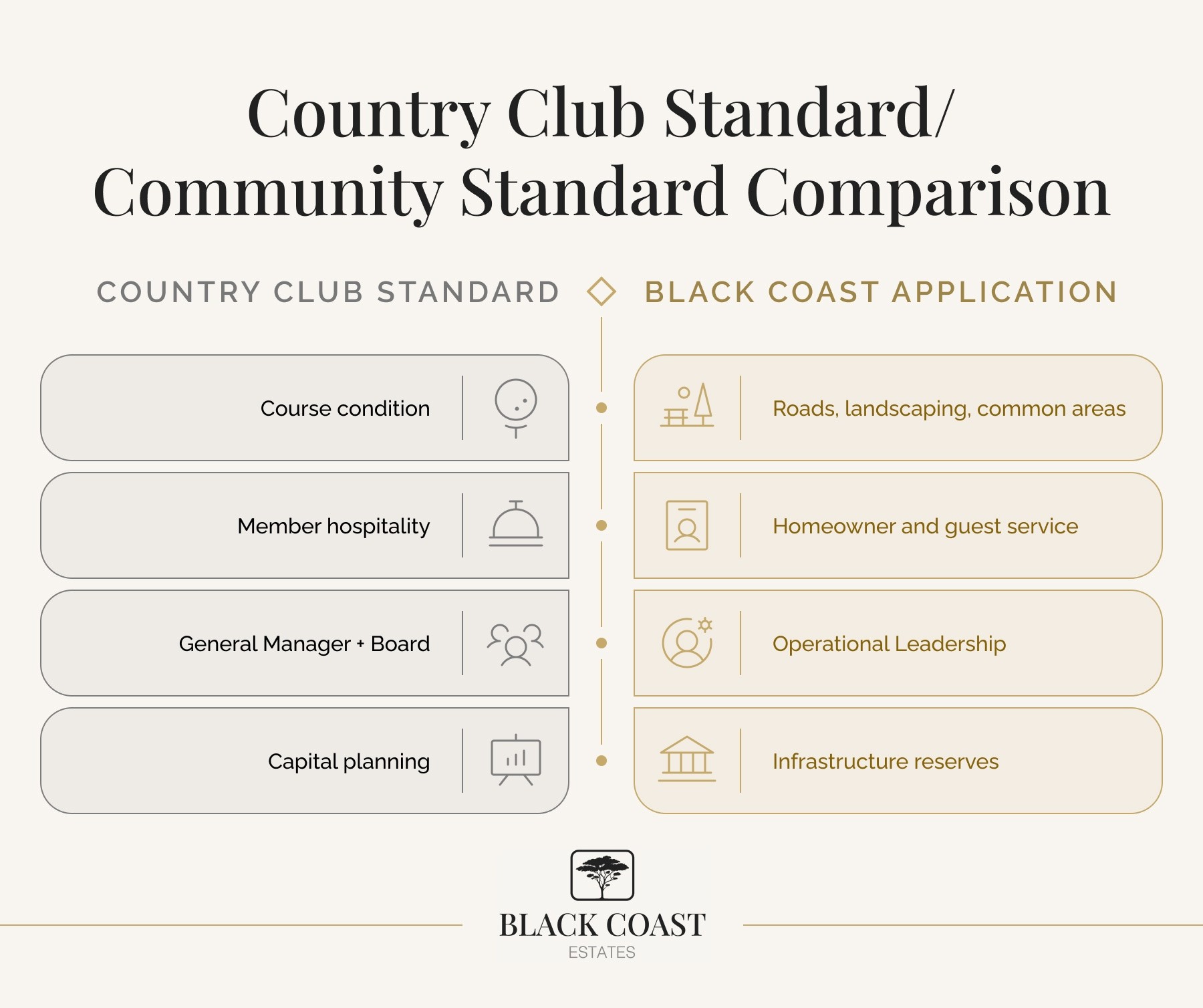
Four things make a great club feel great. We are designing Black Coast around the same four.
Exterior maintenance
At a club, the course is the product. Greens are cut at dawn, bunkers are raked, cart paths are clean, and nothing is ever almost-finished. At Black Coast, the roads, landscaping, and common areas get the same standard of care. When a homeowner or guest drives through the gates, every detail they notice should feel deliberate. That first impression is not cosmetic; it is part of the asset value.
Hospitality of staff
What separates a great club from a public course isn't the grass. It's the people. The starter knows your name. The bag drop recognizes your car. The bartender remembers your drink. That kind of hospitality isn't accidental; it's hired for, trained for, and paid for. Black Coast will be staffed with that same standard in mind.
Operational leadership
Behind every well-run club is a general manager and a board that takes the long view. They reinvest in the asset, hold vendors accountable, and don't let small problems become big ones. As both a homeowner in the community and its manager, I share the same incentives as every member and the operational responsibility to act on them.
Long-term planning
The best clubs replace irrigation before it fails, refresh the clubhouse before it feels dated, and fund reserves so special assessments stay rare. In Costa Rica, that discipline matters even more because the development itself is responsible for its own utilities.
Water, power, roads, and drainage are not the municipality's problem to solve. They are ours. At Black Coast, that infrastructure is master-planned and reserved against from day one, not patched as problems arise.
For owners, the benefit is not just convenience. It is confidence. Confidence that the entrance will look cared for when they arrive, that staff will know how to host their guests, that vendors are being managed, that reserves are being planned, and that the community is not drifting year by year into deferred maintenance. A great club gives members that feeling. A great residential community should too.
Country Club Standards, Playa Negra Soul
The country club analogy only goes so far. A club is, by design, manicured and formal. Playa Negra is not, and that is precisely why people come here. The waves, the dirt roads to the surf breaks, the howler monkeys at sunrise, the small-town feel of the village. None of that is something we want to polish away.
What we're building at Black Coast is the rare combination: country-club-level operations and standards layered onto a rustic, authentic, distinctly Costa Rican setting. The exterior details, the hospitality, the management, and the long-term planning all run at a level homeowners would expect from the best clubs they've ever belonged to — while the place itself still feels like Playa Negra.
That combination is hard to find anywhere in the world, and I'm excited to be both a homeowner and the steward of it.